
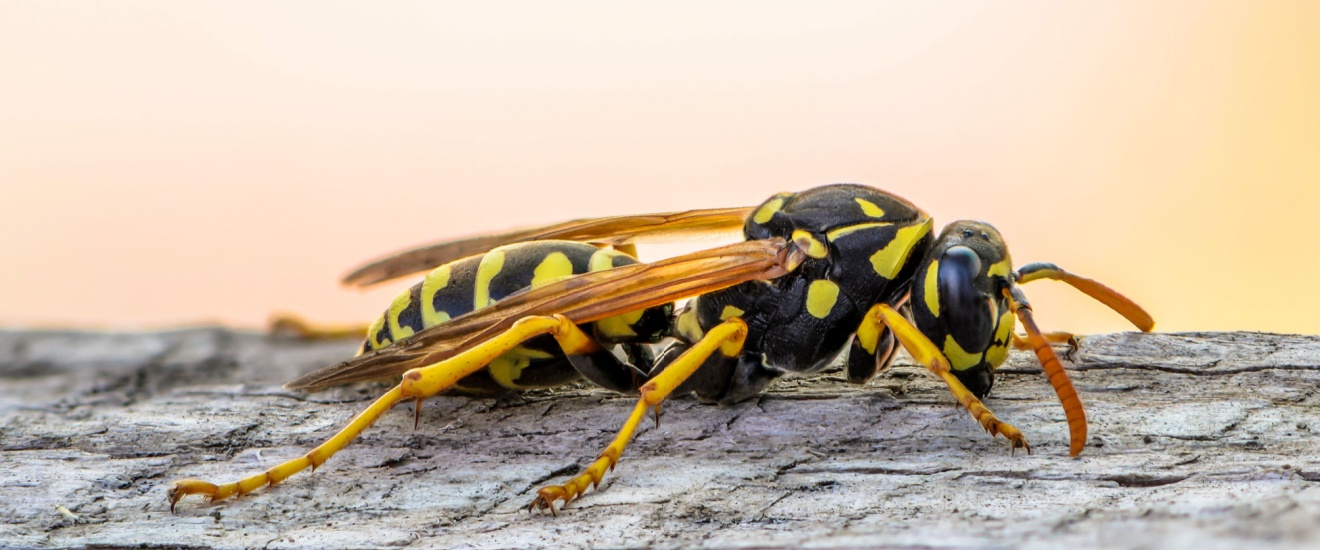
Not every stinging insect poses the same threat—telling them apart helps you respond appropriately. On Whidbey Island, most encounters involve paper wasps, yellowjackets, or bald-faced hornets, and each one looks and behaves differently. Our stinging insect control service handles all three, but knowing which you are dealing with is a useful first step.
Paper Wasps
Paper wasps are slender, with long legs that dangle noticeably as they fly. They are usually brownish with yellow or reddish markings, and they build open, umbrella-shaped nests with visible cells, often under eaves, railings, and overhangs. Paper wasps are generally not aggressive and tend to sting only when their nest is threatened. Even so, they will defend their nest, and a nest near a doorway or a high-traffic area is worth addressing before a family member is stung.
Yellowjackets
Yellowjackets are shorter and stockier than paper wasps, with bright yellow and black bands and a fast, darting flight. They nest out of sight, often in the ground, in wall voids, or in other cavities, which means a nest can go unnoticed until it is large. Yellowjackets are far more aggressive than paper wasps, especially as summer progresses, and they can sting repeatedly. They are also scavengers, drawn to food and drinks at outdoor gatherings, which brings them into frequent contact with people.
Bald-Faced Hornets
Despite the name, bald-faced hornets are actually a type of yellowjacket rather than a true hornet. They are larger and marked in black and white, and they build large, enclosed, gray papery nests that hang from trees, shrubs, or the sides of buildings. Bald-faced hornets are highly protective of their nests and will defend them aggressively if approached. Their nests can grow to the size of a basketball or larger, holding a substantial colony that defends the nest in large numbers.
Why Identification Matters
Knowing which insect you are dealing with affects both the level of caution required and the right approach to removal. A calm paper wasp nest in an open location is a different situation from a hidden yellowjacket nest in a wall or a large hornet nest in a tree. Aggressive species and concealed nests carry a higher risk of multiple stings, which is a serious concern for anyone, and especially for those with allergies. Correct identification also guides how and when a nest should be removed and how much caution the situation calls for. A nest that seems minor may belong to a species that reacts far more strongly than expected.
Handling a Stinging Insect Problem
Because these insects differ in behavior and nest location, treatment is not one-size-fits-all. A professional can identify the species, locate the nest even when it is hidden, and remove it safely with the proper equipment. Harbor Pest Control treats stinging insect problems across Oak Harbor and Whidbey Island and tailors each approach to the species involved. To identify and remove a stinging insect nest safely and completely, request a free estimate and let our trained team take a look.